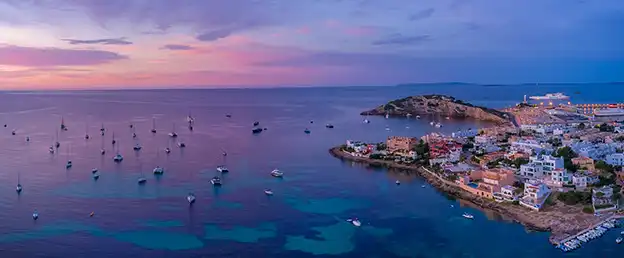
 Sailing Route
2 weeks sailing Balearic Islands
Danielis, 18 Nov 2022


 Filters

How Can We Help With Your Charter?
Share a few details and our team will prepare tailored yacht options and a clear next step.


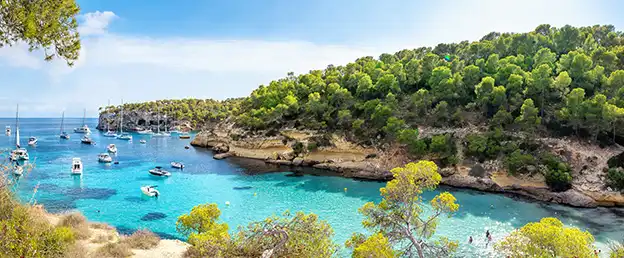
For most sailors, a yacht charter in Spain means the Balearic Islands. Mallorca, Menorca, Ibiza and Formentera rise from the western Mediterranean with hundreds of turquoise coves, long sandy beaches, dramatic cliffs and lively harbour towns, and each island has a completely different character. In a single week you can anchor off a pine-fringed cala with water so clear the seabed looks close enough to touch, walk the medieval streets of Palma or Ciutadella, and watch the sunset from a beach bar on Ibiza, with reliable summer weather and long, bright days almost guaranteed.
The routes on this page are prepared by the Danielis Yachting team. Each one describes a realistic trip at sea, with the stops along the way, the distances between them and the places worth seeing ashore, from one-week loops around Mallorca or Ibiza and Formentera to a two-week voyage around all four main islands. Below you will find an overview of the islands, the best time to sail, the winds to watch, the anchoring rules that protect the Balearic seabed and practical tips that apply to every route in Spain.
The Balearics are close enough to combine in one or two weeks, but different enough that the choice of island shapes your whole holiday.
Mallorca is the largest island and the main charter base, with Palma and its marinas just a short drive from the airport. The north-west coast runs along the Serra de Tramuntana, a UNESCO World Heritage mountain range that drops straight into the sea, with Sóller as its only natural harbour. The east and south coasts are gentler, lined with calas, fishing villages such as Porto Cristo and long beaches like Es Trenc. Off the south coast lies the Cabrera archipelago, a national park and one of the wildest places in the Mediterranean.
Menorca, a UNESCO Biosphere Reserve, is quieter and greener. Its capital Mahón sits at the end of one of the longest natural harbours in Europe, while Ciutadella on the west coast has a narrow, picturesque port lined with restaurants. Around the island you will find small coves with white sand, prehistoric monuments and fishing villages such as Fornells, famous for its lobster stew.
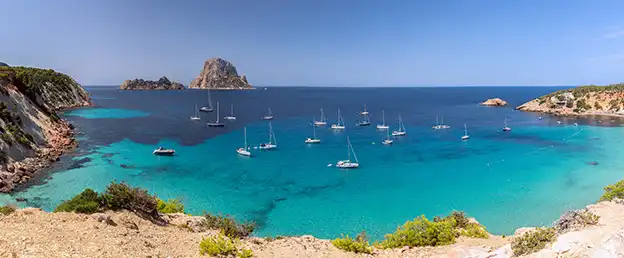
Ibiza is known worldwide for its nightlife, but from the sea it shows another side: hidden calas on the north coast, rocky islets such as Es Vedrà and Conillera, and the fortified old town of Dalt Vila above the harbour. Sant Antoni on the west coast is the place for sunsets, while Portinatx and Cala Benirràs in the north are calmer.
Formentera, just south of Ibiza, is the smallest of the four and feels almost Caribbean, with long white beaches, shallow turquoise water and the sand strip of Ses Illetes. Ibiza and Formentera together are perfect for a relaxed week with short sailing days, while a trip between the larger islands calls for longer passages.
Distances along the coast of each island are short, usually 10 to 30 nautical miles a day between anchorages and harbours. The crossings between islands are longer: Mallorca and Menorca are separated by a channel of a little over 20 NM, while the passage from Mallorca to Ibiza is around 50 NM or more, depending on where you start and finish. A one-week charter therefore works best around one island or a pair of neighbouring islands, such as Ibiza and Formentera or Mallorca and Menorca. Two weeks give you time to sail around all four islands without rushing.
Most charters run from Saturday to Saturday. You board on Saturday afternoon, return to the base on Friday evening and check out on Saturday morning, so plan the longest crossings early in the week and keep a spare day in case the weather changes.
The sailing season in the Balearics runs from May to October, and the mild climate means that spring and autumn are also pleasant. July and August are the hottest and busiest months: the sea is around 25 °C or warmer, the islands are full of life and the most popular anchorages and marinas fill up quickly. June and September are often the best choice, with warm water, steady breezes, more space in the coves and lower prices. May and October suit crews who prefer quiet islands and are happy with cooler evenings.
Summer weather in the Balearics is generally settled, but a few winds shape every sailing week.
On sunny summer days a sea breeze builds along the coasts in the late morning, blows through the afternoon and fades in the evening; in Mallorca it is called the embat. It is a pleasant sailing wind, and many skippers plan their passages for the afternoon and their anchorages for the calm evening.
The tramontana is a strong north wind, often linked to the mistral from the Gulf of Lion. It is most frequent from autumn to spring but can also blow in summer, and it hits the north coasts of Mallorca and especially Menorca with strong gusts and a short, steep sea. When it is forecast, move to the south side of the islands, where the coves are sheltered.
The levante, an easterly wind, can bring a long swell into anchorages that are open to the east, while the poniente and the south-westerly garbí affect the west and south coasts. Because the Balearic coves are small and often open to one side, the key rule is simple: choose your anchorage for the wind and swell expected overnight, not only for the conditions when you arrive. Check the marine forecast every morning; marinas post it daily.
The clear water of the Balearics comes largely from posidonia, a protected seagrass that forms large underwater meadows and gives Formentera and Ibiza their famous turquoise colour. The posidonia meadows between Ibiza and Formentera are part of a UNESCO World Heritage Site. In the Balearic Islands it is forbidden to anchor on posidonia, and inspectors on patrol boats check anchorages in summer and can fine yachts that do. Always drop the anchor on sand, which is easy to see as light patches on the seabed, and use the free posidonia maps and apps that show where it is safe to anchor.
In several of the most popular bays, especially around Ibiza, Formentera and Cabrera, there are seasonal buoy fields that protect the seabed. Many of them can be booked online in advance, and in high season it is wise to do so for the nights you want to spend in a specific bay.
Cabrera Archipelago Maritime-Terrestrial National Park, south of Mallorca, is one of the highlights of any Balearic route, but access is regulated. To sail into the park and spend the night on one of the buoys in its harbour you need an authorisation, which you apply for online in advance, and the number of boats is limited. Anchoring is not allowed inside the park. Other protected areas, such as the Ses Salines Natural Park between Ibiza and Formentera and the island of Sa Dragonera off western Mallorca, have their own rules on anchoring, fishing and landing, so check them before you go.
On a bareboat charter you sail the yacht yourself. The skipper needs a recognised boat licence, and at least one person on board must hold a VHF/SRC radio certificate. If no one in your group has a licence, or you simply prefer to relax, a local skipper who knows the anchorages, the posidonia rules and the best restaurants is well worth it. On a crewed charter, usually on larger catamarans and motor yachts, a skipper and a host or cook take care of everything, and the route is adapted to your wishes every day.
The Balearic marinas are modern and well equipped, from the large yacht harbours of Palma and Ibiza to smaller ports such as Sóller, Fornells, Ciutadella and La Savina on Formentera. In high season they are among the most expensive in the Mediterranean, especially in Ibiza and Palma, and berths should be reserved in advance. That is why most crews spend many nights at anchor or on buoys: the Balearic coves are the real reason to come here, and a week that mixes anchorages, buoy fields and a few marina nights is both cheaper and more memorable.
When you compare offers, remember that the charter price usually covers the yacht itself. Typical extras are the transit log or final cleaning, fuel, marina and buoy fees, a skipper if you hire one and provisions for the week. Marina berths in July and August are the biggest variable, so plan where you will spend each night before you set off. A refundable security deposit is taken at check-in, and with many charter companies it can be replaced by deposit insurance.
Spain also offers sailing along its mainland coast, from the Costa Brava in the north to the Costa Blanca in the south, and in the Canary Islands in the Atlantic, where steady trade winds and ocean swell make for a very different kind of sailing. The routes on this page focus on the Balearic Islands, the most popular and most varied charter area in Spain.
Every itinerary on this page is an example, not a timetable. On board, the plan is always adapted to the wind, the swell and how your crew feels on the day, and a good skipper will happily swap two stops or add a lazy day in a favourite cove. Use the routes to understand the distances and what each island offers, pick the one that matches your experience and style, and let Danielis Yachting help you find the right yacht, the right base and the best dates for your time at sea.
Sailing Route
Danielis, 18 Nov 2022
 Sailing Route
Danielis, 18 Nov 2022
 Sailing Route
Danielis, 18 Nov 2022
Plan your perfect sailing adventure with Danielis Yachting - select your yacht, choose your destination, and set sail!
Contact Us Charter type
 Destinations
Get the best charter deals and tips
Early-booking discounts, last-minute offers and insider route tips.